Taking a look at the collaborative response model.
http://jigsawlearning.ca/
Wednesday, 7 December 2016

Tuesday, 7 July 2015
Monday, 28 July 2014
Reflection of Transformative Leadership
“I’m not in this world to
live up to your expectations and you’re not in this world to live up to mine.”
― Bruce Lee
― Bruce Lee
When I read these chapters I could
not help but think about the philosophies of Bruce Lee, a childhood favourite
of mine J.
The mixture of East Asian philosophies and how they’ve merged with
Western philosophy is a unique fusion of cultures and expectations. This fusion of cultures and expectations is
interesting because of a central argument piece that Carolyn Shields discusses
in chapter five about relationships being a key to equity and inclusivity. Bruce Lee was a primary example of this
living in both east and western cultures, he wanted to belong but “did not”
belong in either culture. The “balance”
that he had to create while having his feet in both worlds must have been extremely
difficult. The quote above highlights
the understanding that the “expectations” that one culture might embody is not
necessarily true in another culture.
This is where the piece of being mindful and being aware of your
surroundings can create ‘thoughtful leaders’.
Bruce Lee was just that, a thoughtful leader, in that he went through
the process of reflection and introspection to make appropriate decisions that
benefit the whole group rather than the individual but not dismissing the
individual during the reflective and introspective process. He was able to hybridize his conflicting
philosophies to create his own unique perspective on what he believed would
benefit the greater whole. This is where
I think Shields and Lee share a similar philosophy on the development of
community and the transformative capabilities a “thoughtful leader” can
achieve.
This perspective of what I believe
Bruce Lee fostered, ties nicely into the concept of fostering global
citizenship. As is stated by Shields,
“transformative leaders must also show concern and raise awareness” (Shields,
pg 242), to create a globally interconnected citizen. In Alberta, our Social Studies 10 curriculum
is based on creating a global citizen through the understanding of
globalization via political, social and economic case studies. So, are students in Alberta in grade 10
social studies becoming global citizens?
A cursory look at the students who graduate from high school in Alberta
would say yes. The majority of students
are engaged and ethical, and foster global citizenship when they leave
school. We hope that students that leave
high school in Alberta are ethical and critical thinkers. The key to fostering global citizenship is
open-mindedness and having the ability to change society as Bruce Lee did when
he decided to rock the proverbial cultural boat. To close, I want to add one more quote from
Bruce Lee that I believe resonates what these chapters discussed:
“A wise man can learn more
from a foolish question than a fool can learn from a wise answer.”
― Bruce Lee
― Bruce Lee
Literature
cited:
Shields,
Carolyn M. Transformative Leadership in
Education, Routledge, New York, 2013.
Saturday, 19 July 2014
Alberta Bound!
The time that I have spent here in Nova Scotia has been re-invigorating. I've learned a great deal and met new people that will forever change my life. Thank you to those people! It has been a blast.
.JPG)
Thursday, 17 July 2014
EDUC 5843 - July 17th - See you again soon! :)
Looking around the room today and I see some of the most creative minds I have ever met! This class has been an exhilarating experience that I won't soon forget. This course has re-sparked my interest in writing and to look at my teaching practice in a different lens. As someone who was not a part of the creativity cohort, those that embraced me with open arms I thank you.
I look forward to meeting you all again as in Chinese culture we don't say good bye, we say "joy gin" which means "see you again soon". Safe travels to everyone and good luck with the upcoming school year wherever you may be!
I look forward to meeting you all again as in Chinese culture we don't say good bye, we say "joy gin" which means "see you again soon". Safe travels to everyone and good luck with the upcoming school year wherever you may be!
Wednesday, 16 July 2014
EDUC 5843 - Learning Ecology - Make the space your own, take ownership!
The discussion today about learning ecology revolved around how one can and should take ownership of the learning environments that they create without fear of ridicule. Using the design process model, we have been able to look at lesson planning in a whole new light for some and to also look at the "big picture" that influences our thoughts about how things are designed, but more importantly, "why" they are designed the way they are.
The text of the Third Teacher, has core constructs of the development of community, meaningfulness(critical thinking) and the importance a learning environment that fosters effective learning for both students and teacher. All of these components have central focus and application in real world situations. For instance, today I had the opportunity to attend the Wolfville Farmer's Market taste of the valley. The experience of community was definitely evident as streams of people entered the market to share stories with friends and colleagues. Meaningful conversations about place, space and time were happening all over the place as I enjoyed a cabbage roll made by a Moroccan, a banh mi sandwich from Vietnam and some bangers and mash from our friends across the pond, the UK. This multicultural atmosphere lends itself to creating meaningful understanding of place and community in a this corner of the world known as Wolfville, Nova Scotia. The design of the market fostered a positive environment for learning, sharing and living in space that allowed for community and critical thinking.
What a great experience!
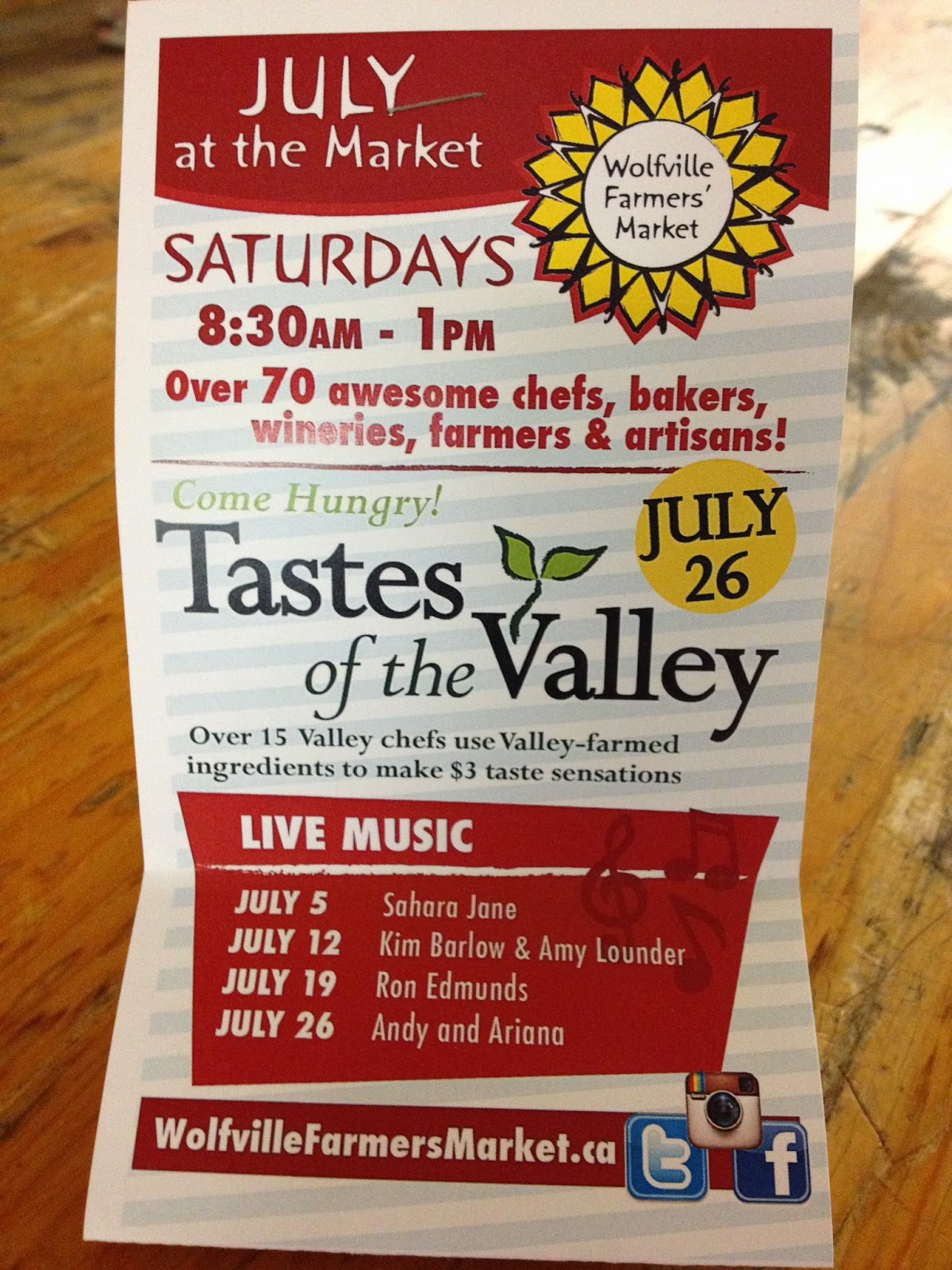
The text of the Third Teacher, has core constructs of the development of community, meaningfulness(critical thinking) and the importance a learning environment that fosters effective learning for both students and teacher. All of these components have central focus and application in real world situations. For instance, today I had the opportunity to attend the Wolfville Farmer's Market taste of the valley. The experience of community was definitely evident as streams of people entered the market to share stories with friends and colleagues. Meaningful conversations about place, space and time were happening all over the place as I enjoyed a cabbage roll made by a Moroccan, a banh mi sandwich from Vietnam and some bangers and mash from our friends across the pond, the UK. This multicultural atmosphere lends itself to creating meaningful understanding of place and community in a this corner of the world known as Wolfville, Nova Scotia. The design of the market fostered a positive environment for learning, sharing and living in space that allowed for community and critical thinking.
What a great experience!
Tuesday, 15 July 2014
EDUC 5843 - July 15th - Learning Ecology
The terminology of the learning ecology is new to me. The model below has the ability to be adapted to various examples ranging from discussions of Facetime, videoconferencing, and iphone usage, just to name a few. The purpose of the tetrad is to critically think about what is working and what may not working, but more importantly to ask the question of: "Why do things work the way the do?". The discussion piece behind the physical, temporal and virtual spaces provides a framework for this discussion as these items exemplify how design process works. For instance, if you have work station in your classroom, you might have: 1) a physical space for the student to work in, the tools necessary to complete the task 2) a temporal space where you give the student a guideline of time of completion of the task ask the question of why the task was done and 3) allow that student the opportunity to virtually create a space that could give quantified data as to the importance of the task.
I feel that the understanding of the design process allows for a different look at what we believe to be quality learning ecology's. We must endeavour to create spaces for learning and adequate time to design these spaces.

I feel that the understanding of the design process allows for a different look at what we believe to be quality learning ecology's. We must endeavour to create spaces for learning and adequate time to design these spaces.
Monday, 14 July 2014
EDUC 5843 - July 14th - Animation Design Day
The construction of our animation projects saw individuals going outside of their creative bubbles and those who shared their expertise to others. It was a great day of collaboration and professional development. The vehicle of education media be it, Windows Movie Maker, Adobe Flash/Illustrator, and PowerPoint created an opportunity to explore comfort zones for each of us. Using technology for some is not an easy task but we've all grown from the experience.
The start of my last week at Acadia was dominated by the development of learning ecology and how it effects me as a teacher. My time here at Acadia has been extremely reflective and there is still more to discover.

The start of my last week at Acadia was dominated by the development of learning ecology and how it effects me as a teacher. My time here at Acadia has been extremely reflective and there is still more to discover.
Sunday, 13 July 2014
Highland Games in Antigonish July 12th and 13th 2014
I had the opportunity to visit Antigonish, Nova Scotia this weekend. The purpose of the trip was to see the Highland Games. I've never seen this event before live...only on TV :). The highlights of the games included, the Farmers Walk, Bagpipers, Weight Toss and the Tug of War. All of these competitions were exemplified by the power and strength of the individuals of their respective disciplines. This was an interesting experience of space and place.
I was able to take in the sights and sounds of this great event of Scottish-Canadian heritage! I highly recommend it! It was a blast!

I was able to take in the sights and sounds of this great event of Scottish-Canadian heritage! I highly recommend it! It was a blast!
Friday, 11 July 2014
EDUC 5843 - July 11th - Luckett's Vineyard and the Experience of Space
Today we had the opportunity to visit Luckett's Vineyard. A gem nestled in the Annapolis valley just outside of Wolfville. A great view of the valley and great discourse in the discussion of educational space. Some core pieces of conversation are:
1) Space is intertwined with what and who you are as an individual.
2) You are influenced by the surroundings that you place yourself.
3) Safety in space is important to consider when creating a positive learning environment.
The connection and comfort level that someone has to ones environment is integral to the output of that individual. NOBODY wants to work or teach or learn in an environment that is toxic.


1) Space is intertwined with what and who you are as an individual.
2) You are influenced by the surroundings that you place yourself.
3) Safety in space is important to consider when creating a positive learning environment.
The connection and comfort level that someone has to ones environment is integral to the output of that individual. NOBODY wants to work or teach or learn in an environment that is toxic.
Thursday, 10 July 2014
EDUC 5843 - July 10th Design Presentation Day :)
What an
interesting day! This course has provided me with the opportunity to go
out of my logical square of absolutes and into a learning space that has
rekindle a dormant creative side to my teaching and leadership praxis. Today's
activity created a rush of different emotions for me, primarily of fear and
excitement. The emotion of fear was
created by the uncertainty of how our project challenge would be tackled and whether
or not we had clearly laid out the process to our classmates. Having said that, there was also a sense of
excitement as to what kind of prototype would be created. With these emotions in tow, I jumped into
today’s class with both feet and got wet both figuratively and actually (thanks Kat :))
I created the wordle below to highlight some of my thoughts about the activity today and how it "CREATED EXCITEMENT AND FEAR" in constructive and positive way!
.JPG)
Wednesday, 9 July 2014
EDUC 5843 - July 9th - What is design?
What is in a design?
Time and space is a guiding factor of design to create a sense of a transcended environment. We discussed Feng Shui today and the influential nature it has on perceived environment. To create an environment for student gain/learning is to meld management and functionality.
The ability to design something useful is meant to create a question of "why" things are designed the way they are. This reminds of a quote/interview that was done with Bruce Lee. The interview was highlighted by the power of water and it's ability to be formless. (Bruce Lee Interview - Be Formless )Design can have a level of formlessness because of the need for adaptability is paramount but in order to engage a target audience something needs to be simple and engaging.
Design elements and principles need to be understood to create analogous theories that are functional textures, space, shape and color. Quick judgements and "thin slicing" theories requires an open mind and then relevance to educational environments. Principles of design: contrast, repetition, proximity, alignment. The ability to use these principles to form and build designs allows for familiarity and support.
The discussion of todays class on design was very enlightening and being in a room of creative people has made me think outside the proverbial box.
Cheers
Quote from Bruce Lee
http://www.goodreads.com/quotes/163198-you-must-be-shapeless-formless-like-water-when-you-pour
Time and space is a guiding factor of design to create a sense of a transcended environment. We discussed Feng Shui today and the influential nature it has on perceived environment. To create an environment for student gain/learning is to meld management and functionality.
The ability to design something useful is meant to create a question of "why" things are designed the way they are. This reminds of a quote/interview that was done with Bruce Lee. The interview was highlighted by the power of water and it's ability to be formless. (Bruce Lee Interview - Be Formless )Design can have a level of formlessness because of the need for adaptability is paramount but in order to engage a target audience something needs to be simple and engaging.
Design elements and principles need to be understood to create analogous theories that are functional textures, space, shape and color. Quick judgements and "thin slicing" theories requires an open mind and then relevance to educational environments. Principles of design: contrast, repetition, proximity, alignment. The ability to use these principles to form and build designs allows for familiarity and support.
The discussion of todays class on design was very enlightening and being in a room of creative people has made me think outside the proverbial box.
Cheers
Quote from Bruce Lee
http://www.goodreads.com/quotes/163198-you-must-be-shapeless-formless-like-water-when-you-pour
Subscribe to:
Posts (Atom)